Author Margaret Dowland
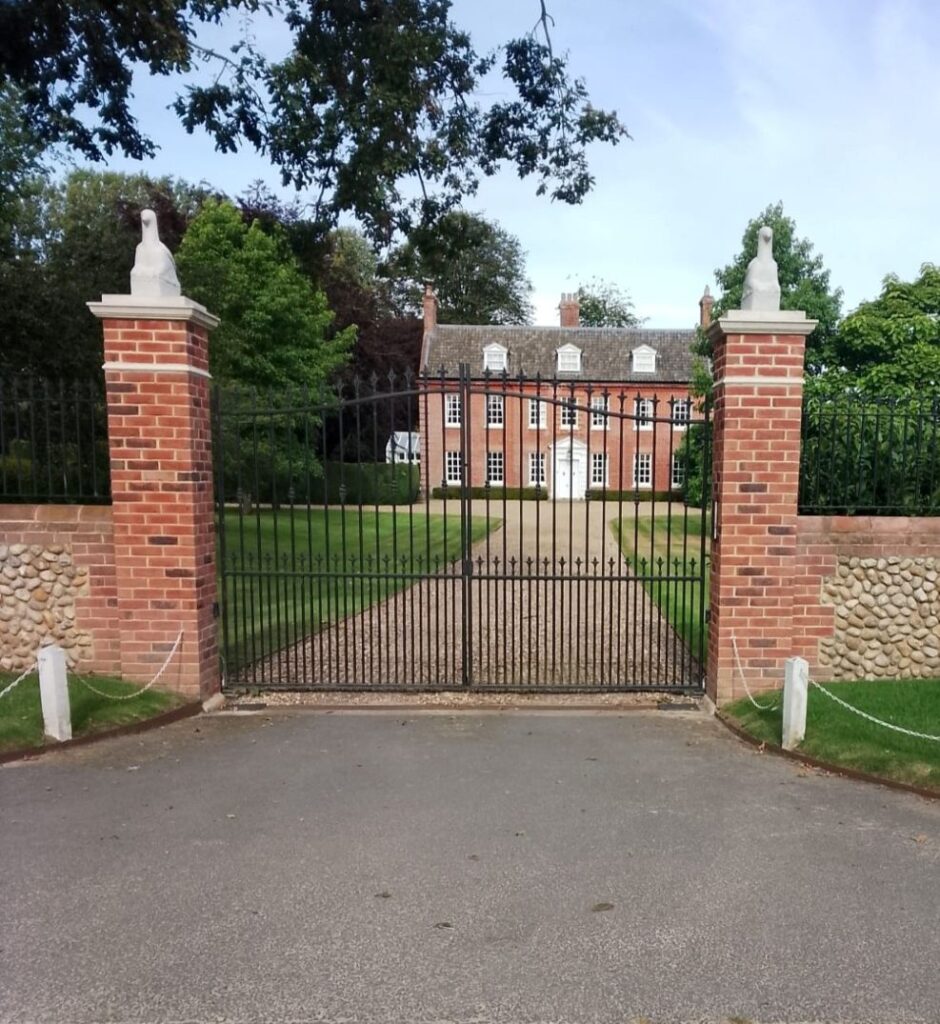
The Hall has a façade of seven bays, on two storeys and attic. The three central bays are slightly projecting. The quoins are rusticated, and the central doorway has rustication, keystone and moulded pediment all in brick. The windows are sashed with glazing bars under flat arches; the central one on the first floor has a rusticated surround and the two flanking ones moulded arches. The first-floor windows all have flat wooden hoods. The eaves cornice has moulded modillions, and the attic windows have timber pediments. The bond is an inversion of Monk Bond with two headers between each stretcher.
The south gable wall has two oval openings at first floor level, two modern openings below. There are rusticated quoins, and the returns of the front and rear cornices continue as a platband, below a small attic window, some chequered brickwork was noted in 1978.
The north and south walls have internal stacks. The north wall has a gable of flint above the platband below this the wall is rendered.
The west face or rear has a turret projection and a two story catslide (this is a roof that extends down to cover a single-story extension). The stair turret has a ground floor of flint with brick quoins and an upper storey of brick.
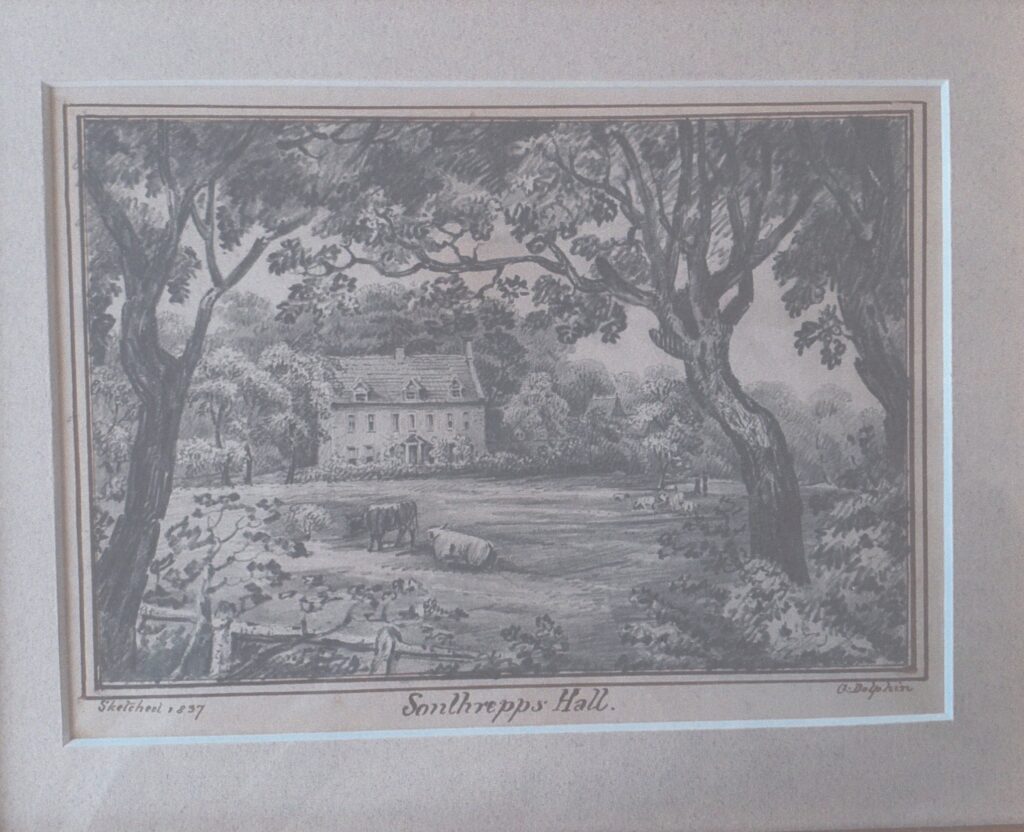
The Hall as we know it today was probably built in about 1750 but there have been buildings on the site for many centuries before that. All the land was given to William De Warenne in 1066 and on his death passed to the Duchy of Lancaster. It would have been farmed out to local landowners by way of leases. It is thought that through this connection that ownership passed to the Nunnery of Bruisyard in Suffolk which was founded in 1366 forming a small Manor.
At the dissolution of the Monasteries by Henry VIII in 1539 the Manor was granted to Sir Nicholas Hare who quickly disposed of it to the Gresham family. It would appear that at this time the Hall was nothing more than a Yeoman’s dwelling. The first identifiable owners of the Hall would seem to be the Bateman family who lived in Southrepps from the 15th century, but only identifiable with the Hall from the 17th century. The Manor Court Books refer to Robert Bateman senior and Robert Bateman junior as having copyhold lands which later formed part of the Hall estate. They were yeoman farmers. They may or may not have lived in the dwelling that was there at the time. The next owner was Jerome Blofield who didn’t live there.
There is then a blank after his death until 1673 when Robert Framingham of Stiffkey – a tenant of the Manor of Southrepps Brosyard – surrendered all his copyhold property of the Manor to his daughter Susanna Fiske (widow). Robert had owned the property in 1658 as he applied for permission to demolish a building in that year. Susanna is thought to have rented out the property. She left the estate to her son Robert Fiske and if he had no heirs it was to go to his sister Susan, wife of William Churchman.
Robert died without heirs but instead left the property to William Framingham the elder, his nephew, and then to William’s son Robert, not to his own sister Susan as per his mother’s will. At the Manor Court on the 2nd Jan 1721/2 Susan gave up all rights to the property, which went to Robert, who was a cousin. He remained owner until 1733. At no time did he live there
In 1733 James Dawson bought the property by having a mortgage with Robert Framingham; this was eventually paid off in 1750. James was the son of Stephen and Elizabeth Dawson, who had possibly been the tenants of the Hall from 1703 when James’s brother Thomas was born. In his will, Stephen left his wife and son James, (Thomas having died) the remaining years of any lease of property in Southrepps. If James was the sitting tenant, it would have put him in prime position to purchase the Hall, the mortgage he took out with Robert Framingham being greater than any income Robert would have received under a lease. James is the most likely candidate for building the Hall we see today.
James and his wife Sarah nee Fiddy would appear to have lived at the Hall as all seven of their children are baptized and sadly buried at St James. His daughter Mary lived to be the oldest at 24.
With no immediate heirs and all his siblings predeceasing him he writes his will in 1772 and leaves his estate to Robert, the second son of his sister Elizabeth Ellis.
In this will he makes the most interesting provision.
“That Sarah my wife shall and may have sole use (for the term of her natural life or so long of such a term as she shall continue my widow and unmarried and no longer) of the Great Parlour Hall and Hall Chamber of my Capital Mansion House and the liberty of the Staircase and Stair Case Room with liberty at all times of Cooking in the Kitchen Brewing and Washing in the Backhouse of the aforesaid Mansion House and the sole use of the New Cellar and Liberty at all times of taking water at the pump Liberty of laying Firing in some convenient place in the Yard and the sole use of half of the Garden next to the Home Close with free Passage to and from all usual Ways and Passages And also sole use of my chariot.”
From what is known of the Hall today the hall is no doubt the entrance hall, with the hall Chamber immediately above it. The great parlour room could be either of the rooms adjoining the hall; the reference to the staircase and staircase room fits with what exists now. James died in 1788 and Sarah in 1803, and is also buried at St James.
It is unclear when Robert Ellis and his family move to Southrepps. It may have been before James died, but what is known is that Robert and Mary’s son John Diboll died at the age of 31 in 1788 and is buried at Southrepps, which suggests that the family lived in the area.
Robert Ellis had no surviving male heir, but his daughter Elizabeth Hodson had children. Robert died in 1802, and his widow Mary continued to live in the Hall until her death in 1829 at the age of 92. With her death the property was inherited by her daughter Elizabeth. Elizabeth had married Thomas Hodson of Lewes in 1787 in Southrepps, and it is clear that the marriage is not a success, as we shall see later. Elizabeth doesn’t live at the Hall but White’s directory of 1839 puts her as resident in the parish. The Tithe apportionment map of 1839 has her as occupier of number 46 on the plan: this is The Grange.
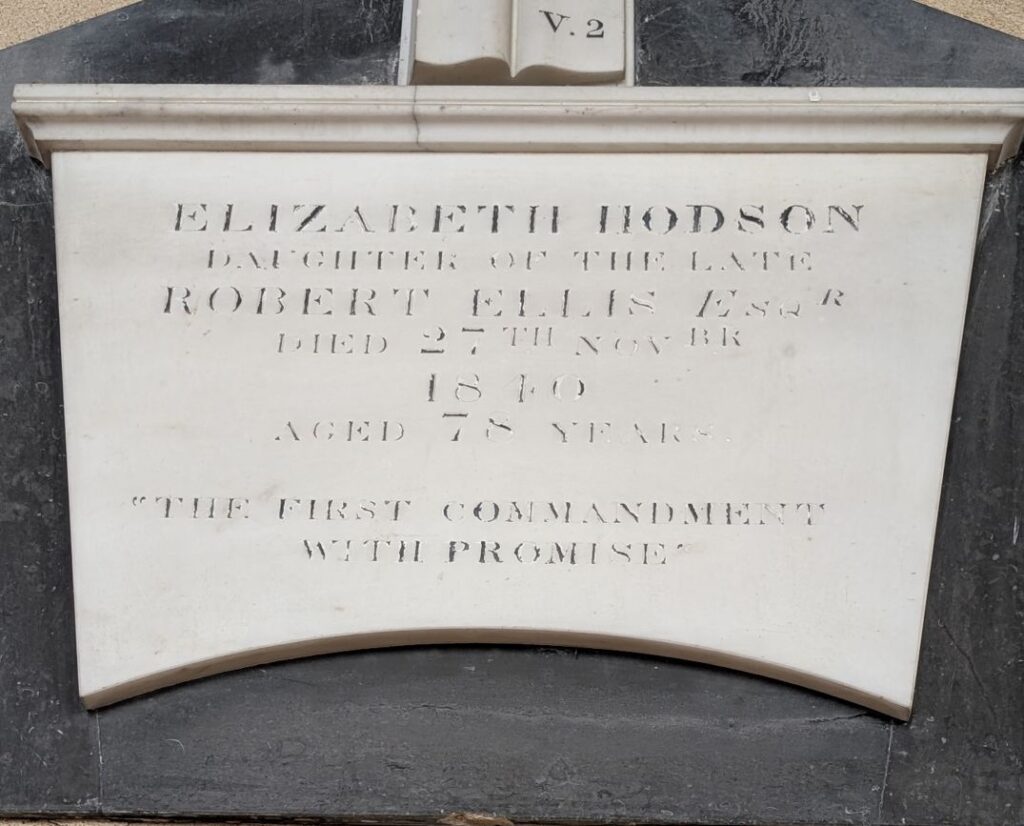
On her death in 1841 Elizabeth left nothing to Thomas Hodson but everything went to her surviving daughter Elizabeth junior (born in Lewes in 1789) and her husband the Rev. Edward Bull (who she married in Lewes in 1829) under the terms of settlement of Roberts Ellis’s will. There are then some legal complications with the trusts and settlements and other members of the Bull family which take many years to unravel. When it was all eventually settled Rev. Bull sold the whole estate to Lord Suffield in 1870, Elizabeth his wife having died in 1844 in Essex, where the family lived.
In 1830 a new rector arrived at St Mary’s Antingham – the Rev. John Dolphin. As there was no suitable residence, he leased the Hall until 1844 when the new rectory in Antingham was built.
The Hall was again let to tenant farmers, the most likely contender being John Nichols from possibly 1851. In 1881 he was replaced by George Plumbly who was still there in 1891. The estate was sold in 1919 to the Tyler brothers.
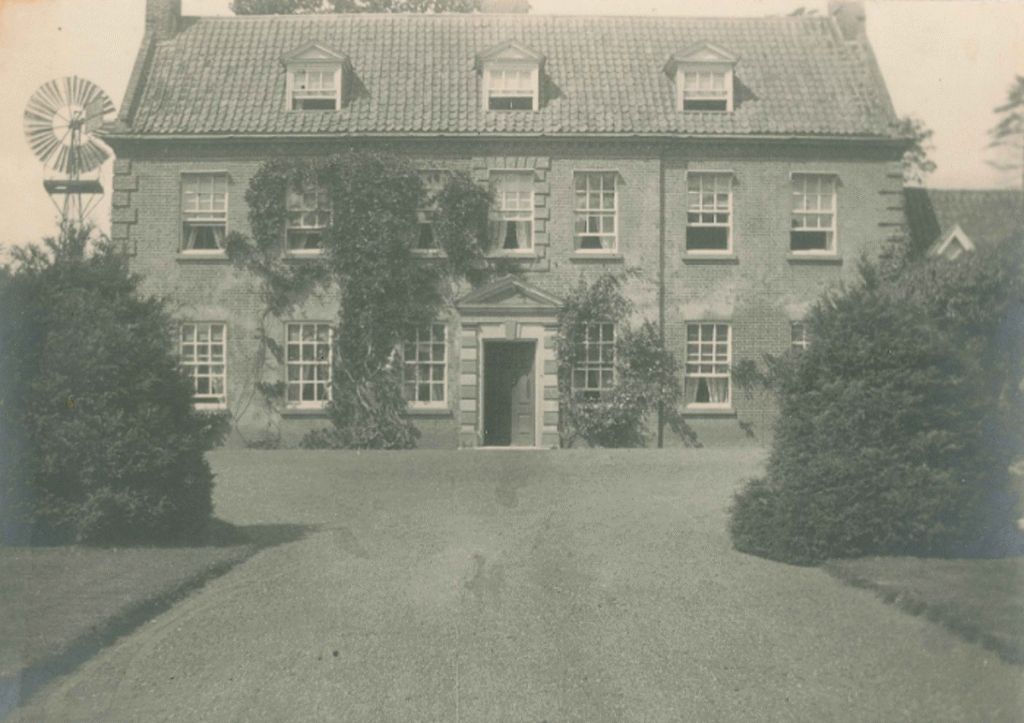
Then in 1950 to Mr. and Mrs. A. Colman, who undertook much renovation, and in 1979 to Peter Sladden.
Various historians have looked at the Hall over the years. The new façade does date to the early 1700s. There are foundations that pre-date the rebuild. A previous owner talked of having demolished the Tudor cottages. When Basil Cozens-Hardy reported on the Hall in the 1960s he made mention of Tudor mullion windows which are not present. The speculation is that the present building was built on or over the south end of an older building (so that the latter could be inhabited until it was complete) and that this older building was then converted to stables and office, its front wall being demolished and rebuilt to match the new Hall façade – the original foundations being reused.
The small probably Tudor building that the Batemans and Bloefield families had known gradually increased in size and grandeur as the occupants rose in the world.
With thanks to Charles Farrow Research who had done much of this research for Peter Sladden.
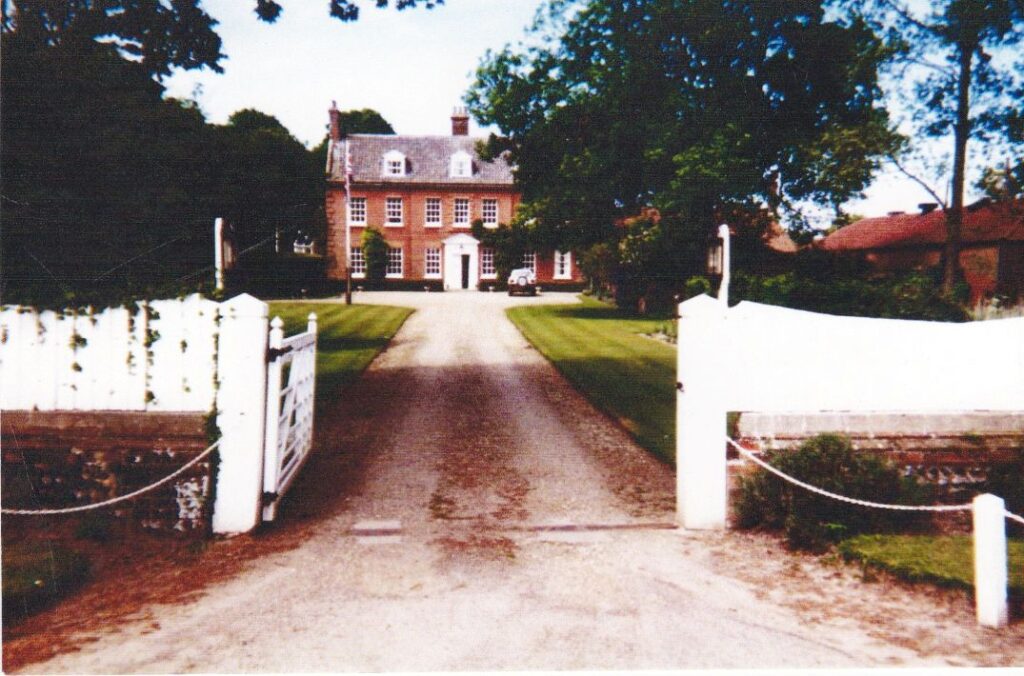
The Hall today has new boundary walls which also enclose the pond. Peter Sladden also planted the Southern Rhodesia Memorial Avenue which lines up with the church tower. He and his wife Evelyn are both buried there. Peter Sladden made his living in Southern Rhodesia (Zimbabwe). From 1980 until his death in 2017 Peter Sladden held a Flag raising ceremony with members of the Springbok Club commemorating the raising of the Union Jack in Salisbury, Southern Rhodesia in 1890.
The estate has expanded and now trades under the name of Wayware Ltd., and is still run by the family.