
Henry Wood designed Antingham and Southrepps School
Author Diane Lea-Jones
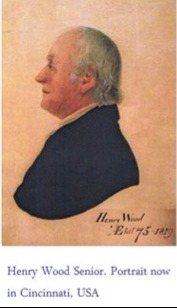
Cleaned digital
copy of original
portrait, with
date (correct)
also copied &
transposed
from back of
painting, ©
Julian Lea-
Jones,
Restorer.
Henry Wood, my 6th great grandfather, was born c.1744, probably in Norfolk. He married Ann, (maiden name unknown), and had at least ten children.
When he moved to London c. 1770 he was described as a Carver and Gilder and lived initially just behind St. Martins in the Fields.
In 1771 he was working with Henry Holland at Claremont House, Esher, the home of Lord Clive, where he made Corinthian capitals for the portico, matching pilasters and horizontal Corinthian modiglions for the cornice and three masks of satyrs for the keystones to the arches of the steps on the north front. At this stage he was described as a Carver in Wood and Stone. Lancelot ‘Capability’ Brown was also working on this estate so there is a fair chance that they were known to each other.
In 1775 he worked at Benham for Lord Craven where he made six ionic capitals to the pilasters in the front of the house and four trusses to the frontispiece, together with fireplaces for the billiard room, the library and a bedchamber.
In 1778 he received a letter from ‘his great friend’, Sir John Soane, who was on a scholarship tour of Italy. Henry worked with Soane on Holland’s Hans Town development.
In 1787 he was working at Althorp undertaking carving and gilding as the Principal Mason under Henry Holland. Lancelot, Henry Wood’s son, carved a fireplace for the south drawing room there in 1802.
In 1787 Henry was working at Bedford House, Bloomsbury Square, for the 5th Duke of Bedford and later that year he supplied the ballustrading for the south front of Woburn Abbey. He built the sculpture gallery and carved the rich ornamental friezes of antique foliage in the dining room and probably the enrichments in the library. He also built the quadrangle and an entrance lodge.
In 1788 he started work on Carlton House, the residence of the Prince of Wales,( latterly George IV) making the vaults of the basement, the stables, various fireplaces, pilasters, columns, 37 ionic capitals for the forecourt screen and bronze crests for the screen arches. He did the decorative carving for the riding houses and made chimney pieces for the lower eating room adjoining the Chinese room, for an ante room and for the Bow room, lower storey. When Carlton House was demolished the fireplaces were transferred to Buckingham Palace where they are to this day.
In 1794 he signed an agreement to build the Blicking Mausoleum for Lady Caroline Harbord at Blickling, Norfolk, jointly with Joseph Bonomi. He worked on this until 1796 at least.
In 1796 he designed Thorpe Market Church in Norfolk for Lord Suffield and fireplaces for the Duke of Bridgwater at Cleveland House, Cleveland Row, London.
In 1801 he made marble chimney pieces for Lord Romney at The Mote, near Maidstone, and during that year he moved to Bristol when he bought the yard and business of Thomas Paty.
Once settled in Bristol in 1802 he built Lower Lodge, Ashton Court estate and in 1803 the Poor House at the junction of Eastfield Road and Waters Lane in Westbury on Trym. The house has been demolished but the cellars still exist under the large house behind the high stone wall at the end of Eastfield.
During his time in Bristol he still undertook commissions such as Merthyr Mawr House, Mid Glamorgan, for Sir John Nicholl, the village school at Thorpe Market, Norfolk for Lord Suffield, and three houses in Clapham Road, London.
Memorials made by Henry Wood can be found all over England and also in Ireland and the West Indies.
Henry invented a method whereby a liquid preparation was applied to all the timbers used in a building which, when dry, was said to render them almost incombustible, and filed a patent for a ‘Time Setter’, an early type of mechanical diary.
Henry died in 1828 and is interred in Westbury on Trym Parish Church where there is a plaque in his memory above the side door. Ann, his wife, died in 1814 and she is also buried here, together with Isabella, one of his daughters, who died shortly after her marriage to Hall Wake, Henry Wood’s Foreman. Of his ten children, several of his sons followed in his footsteps with varying degrees of success. Lancelot, his eldest son, worked in London where he made the memorial for the founder of the Chelsea Physic Garden in Chelsea Old Churchyard.
George worked in Gloucester and married the daughter of John Bryan, the mason to Gloucester Cathedral. He built the obelisk at Eastnor Castle.
Thomas worked with Thomas Symonds in Hereford and built the Nelson Monument on Castle Green.
Lancelot’s daughter, Elizabeth, married Adolphus Cherrill and emigrated to Carthage in America. One of their descendants was Virginia Cherrill, the film actress, who was the second wife of Cary Grant. Through this branch of the family there are connections to President Theodore Roosevelt. Lancelot’s son, Lancelot Edward, was a Major in the 54th West Norfolk Regiment and on his death left money to buy a lifeboat which was stationed off the Norfolk Coast and was named after his regiment.
©Diane Lea-Jones. January 2017.
Diane also sent us this article about the Time Setter that Henry Wood invented.
For a Time Setter
On the 12th of April last, Mr. Henry Wood, Statuary, of Sloane Square, in the parish of of St. Luke, Chelsea, obtained a Patent for the invention of a time-setter.
In the construction of this time setter, he takes a common dial plate, such as is used for watches or clocks. It may be round, square, oval, or of any other similar figure. He inscribes upon it the hours and minutes which mark the usual divisions of the day. Next, considering what particular round of daily employment it is wished to indicate, he inscribes also, the names of these upon the dial-plate; the name of each employment, at the numerals of the hour and minute at which it is to be performed. Hands or sliders are then to be adapted to the dial-plate thus marked. The plate, with these hands, are to be fitted, after this preparation, to the usual machinery of a watch or clock. The movement of the hands will incline to the time for the different employments specified on the dial-plate, as it points, successively, to the hours which were marked for their performance. The hours for prayers, for dinner, for retirement to rest, or from any other similar office of life, may in this manner be indicated by the revolution of the hands of Mr. Wood’s invention. The machine may be fitted to tables, walls, doors, or any other piece of furniture. Not only the diurnal tasks of life, but those, also, which recur after much longer intervals, may be, in this manner, suggested to recollection. It is easy to perceive, that this contrivance, though, in truth, extremely simple, may be happily applied to many important and elegant uses.
The Scots Magazine Vol. 61 1799