
This is a transcript from Norfolk Remembered by Robert Bagshaw who died in 2008.
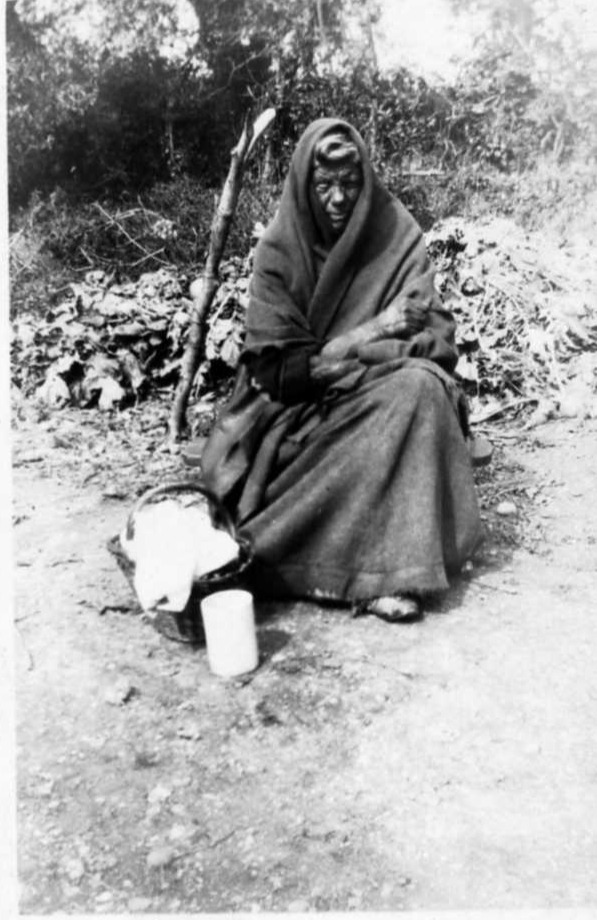
Louisa or Lou as she was affectional known as, came from a good family background and it was her own choice that she should foresake the comforts of home for the open road. Nobody is certain why she came to this decision, but it is generally belived to have resulted from a broken romance while she was working at Trunch in her younger days. Her wanderings took her over a wide area of North East Norfolk, stretching from North Walsham up as far as Northrepps, through Trunch and Riddlington to Stalham and back to the North Walsham area, not forgetting the dozens of villages in between. Dressed all in black, with her long skirts hiding her feet, she wore a shawl over her head and carried her belongings in a sack slung over her shoulder or sometimes in a kind of wicker basket. Everywhere she went she became a familiar and much loved figure, and the emotion which transends all others in the minds of those who still remember her is one of compassion, almos tof love.
Obviously well-educated, she was quiet in her speech, with a marked tendency towards quoting from the Bible. Perhaps it was her religious leanings which influenced her choice of sleeping quaters for, while it was the custom for barns and outbuildings to be left unlocked for her whenever she was known to be in the area, she seems to have had a marked preference for church porches. A lady whose mother used to clean the little church of Beeston St Lawence recalls that it was quite a regular thing to find her asleep on the stone floor of the porch at 5 o’clock on a Sunday morning. ” She would waken at our approach” she told me “and with a polite “Good Morning” would put on her hobnailed boots and move off. She made the same choice at Bradfield and also Lessingham where the verger often came across her lying in the porch and would tread quietly past so as not to disturb her(we know she also made the same choice sleeping in the porch at St James Southrepps).
Lou was never known to beg for either money or food, but many a householder answered a knock at the door to be greeted with a request for water or a cup of tea. At Lessingham, however it went slightly further, for there it was the custom for her to present herself at the vergers cottage with apples that someone had given her. These the vergers wife would turn into delicious apple dumplings with lashings of brown sugar. Even then, however she resisted all attempts to persuade her to go inside the cottage to eat them, preferring instead to take her meal on the little wooden bench outside the back door. Then, with a polite word of thanks, she would go on her way.
Although the story of Lou Pestell is tinged with sadness, it is not without its lighter moments. In particular, there was the very dark night, with heavy black clouds and no moon, when she settled down in the porch of Bradfield Church. At the same time, a poacher was going about his business in the nearby woods until, almost without warning, the heavens opened up and torrential rain began to fall. Looking for shelter, the poacher hurriedly made for the church porch where he sat down to await the end of the storm. Because of the darkness and the fact that Lou was dressed in black, he was completely unaware of her presence until, suddenly a hand came up out of the darkness and tapped him on the shoulder and a voice said “what’s the time mister?” The poacher lept up in panic and, dashing through the rain, made for the safety of his home, where he vowed that never again would he set foot in Bradfield Church.
Lou led the life of her choosing for many years until in 1933, she became ill and was taken to Aylsham infirmary where she died at the age of 73 There are many who deplore the fact that she was allowed to engage in her particular kind of life, but anyone who knew Lou would have been aware that, for her, a life between four wallls would have been like a prison sentence. As it was, she was allowed to lead her life in the way she wanted, without interference from anybody, and who could want for more?
Although there are none left in Southrepps who remember her directly there are many who knew of her through their parents and the tales they were told correlate exactly wth the account above.