Introduction
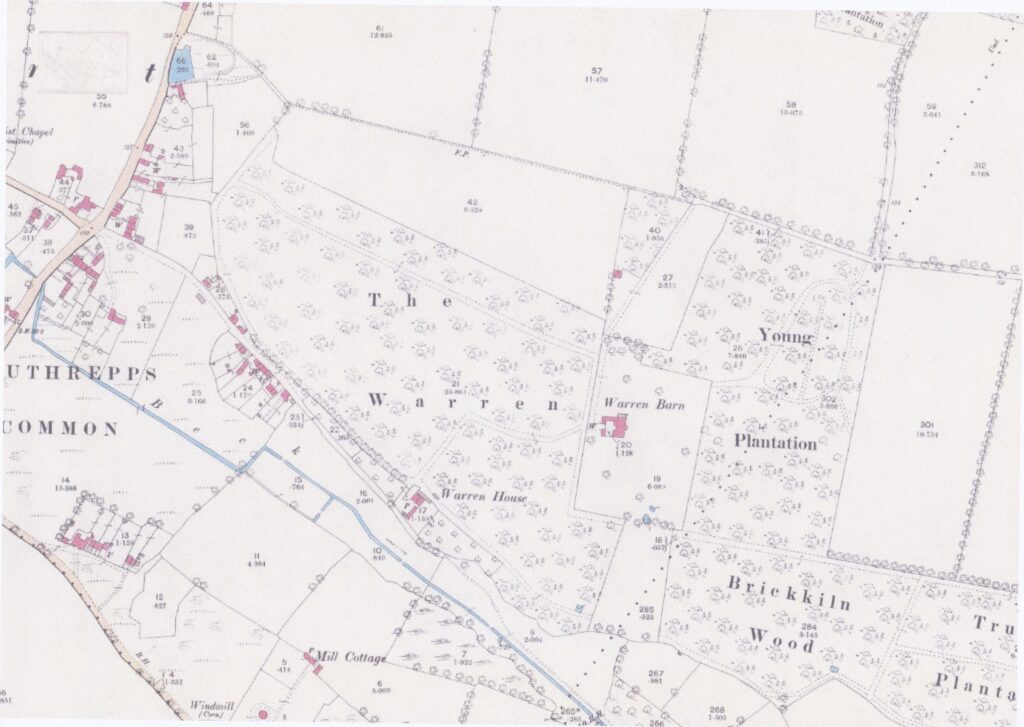
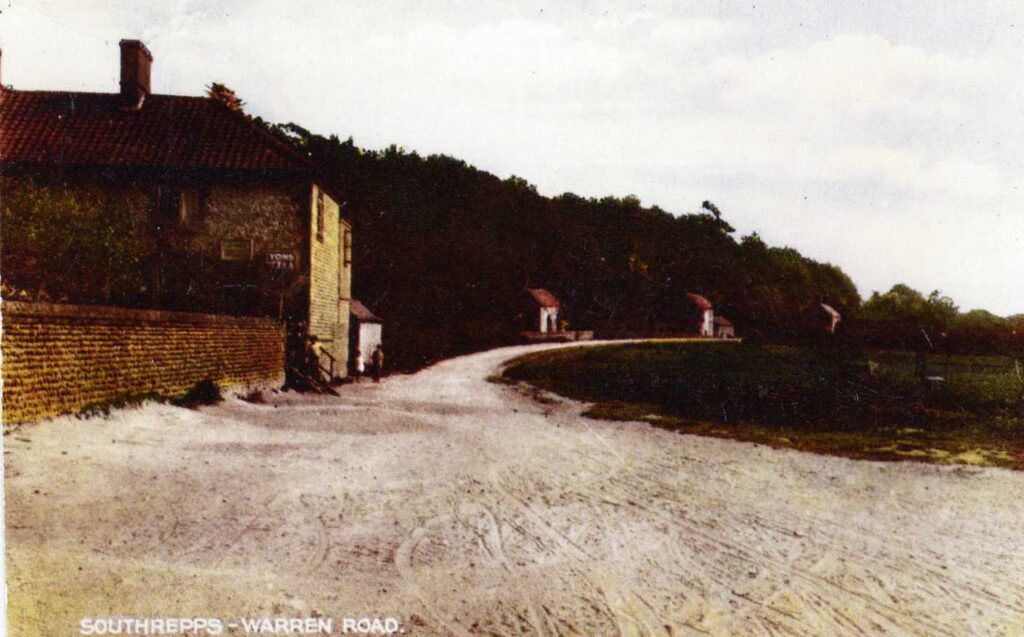
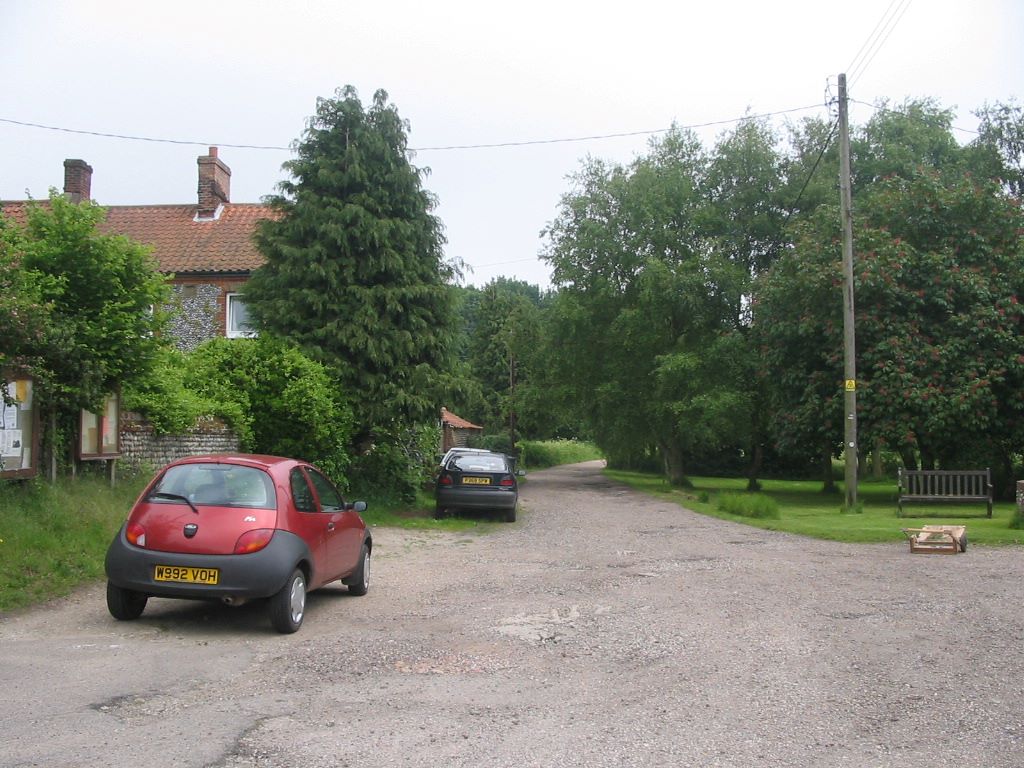
Warren Road is an unmade road in Lower Street that runs from the village sign to the Anglian Water sewage works at the far end, it is a cul-de-sac. At the crossroads end it adjoins a flat area of trees and amenity grass affectionately known as The Hill, which has been in past years been used for small fêtes. This then leads on to Southrepps Common. The field on the North side of the road is owned by Garden Farm. The Gunton Estate map of 1784 shows no properties owned by the estate. This does not mean there were no houses. One hundred years later there is a significant number of houses on the road.
The Nest

The Nest was originally a small cottage. It is built of brick and flint, and is clearly visible on the 1886 OS map of Warren Road. It is likely that it had previously been owned by the Buxton Estate before being sold to William Aston Green, as were Five Acres and numbers 4 and 5 Warren Road. In 1933 Mr. William Allen and his wife Elizabeth lived there. Their son John Allen was renting and living in the Bungalow (Larks Rise) at the time. Their son-in-law Frederick Knights bought the house, the date of the purchase possibly in the 1930s as that is when he bought Five Acres. He also bought the Bungalow (now Larks Rise). The Allens continued to live in the cottage until their deaths in 1945 and 1948. Frederick’s second daughter Edna Punchard nee Knights moved into the cottage in 1950, having been gifted the property by her father. Edna died in 2013. Her grandson has since moved into the family home. It has been substantially extended.
Five Acres

Five acres was originally known as Warren Cottage. It was a two-bedroom knapped flint cottage, which in 1867 belonged to the Buxton Estate. It is believed to have been built as a game keeper’s cottage. It backs onto The Warren,which was also owned by the Buxton Estate. James Pitcher is listed as a gamekeeper living in Lower Street in 1861, and continues to be listed as gamekeeper living in Lower Street until the 1901 census, when his address is given as The Warren. In 1921 two gamekeepers are shown as living in Lower Street: Charles Smith works for the Buxton Estate and William Dix gives his address as the Warren, as he did in 1911. Unfortunately, we cannot confirm that any of these gentlemen lived at Warren Cottage.
In 1928 the cottage and several acres were sold to William Ashton Green who owned other properties in the village. Ashton Green rented the property to Mr. JE Allen. In 1938 Frederick Knights of Garden Farm Pit Street (JE Allen’s brother in-law) bought the cottage. At first Mr. Ashton Green was going to rent the land with the understanding that Ashton Green still held the right to shoot rabbits on the land if they were found to be a nuisance to his tenant farmers, however he decided to sell instead. Frederick’s recently married daughter Joyce and husband Cecil Larke came to live in the cottage.

In 1939 the young couple were hosts to two evacuees from London – Barbara and a second child Margaret Corbett. (Barbara remained in contact with the family until her death in Australia at the age of 99 – she had much enjoyed her time in the countryside). The children arrived with a suitcase each and a gas mask. Barbara married George Cooper in 1948 and they emigrated to Australia. On a holiday in 1989 she was able to participate in the 50th reunion of the evacuees and she signed the school log book, as did all the other attendees.

The family still has bills from when Reynolds of Sandy Lane undertook alterations to the cottage in both 1938 and 1949.
In 1951 Fred Knights gifted the property to Joyce. They raised their two children, Peter, who now owns Garden Farm, and Nancy. In 1973 Nancy married Alf Rayner and moved to a newly built bungalow in Bradfield Road. On the death of Nancy’s mother in 1977 they returned to Five Acres to live with her father Cecil. The house was extended to cope with the growing family. Cecil died in 1983 leaving the house to Nancy. With five children the house was twice more extended, in 1983 and 1986.

Nancy says of her home “We have lived in Five Acres for 47 years and it is not just a house but a home of much love and happy memories. A house which has been in the same family for 87 years.”
She also recalls baths in front of the fire with the water from the well. It was drawn from the well by an electric pump into a pressurised tank and then pumped to a single cold water tap in Five Acres and to the Nest, next door. It was then heated in the copper. The cottage also had an outside toilet. Her father kept pigs and hens. The Nissan hut that can still be seen in the garden was manufactured to house the troops but as war ended it was surplus to requirements and sold off. Cyril bought it: it came crated up and unused until it became the chicken house. The family also grazed Lucy the goat on the Common and dried their washing there. Nancy once caught a very large eel in the beck in the 1960s when her grandfather dredged the stream; she brought the eel home in a bucket.
Larks Rise
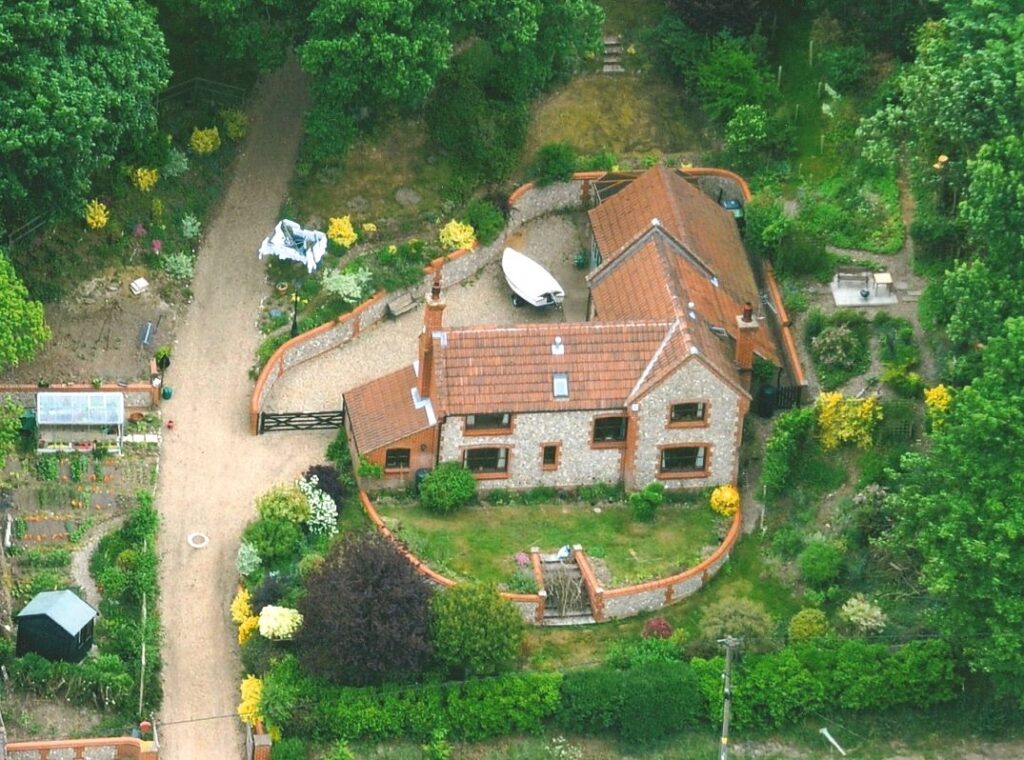
Larks Rise was built on the site of a previous smallholding. The land having belonged to The Buxton estate, then William Aston-Green who sold it to Frederick Knights. It incorporated a small prefabricated bungalow alongside numerous outbuildings. These were spread over an acre of relatively steep rising land. Using the 1939 register it is possible that Charles and Edith Bell lived here with at least one evacuee, Eric Maton. Probate for Charles Bell in 1957 gives his address as The Bungalow Warren Road.
When it was bought by Ed Potter the residential property was considered to be in too poor a condition for refurbishment and so permission was granted for complete demolition to be replaced with a new-build for which plans were approved in 1994.
The new dwelling was designed by architect Jim Bond with a remit to reflect the proportions and materials appropriate to the vernacular characteristics of the area. The house was constructed using tradition brick and flint-work and set in 12 acres of woodland which was purchased separately.
The house was completed in 1996 and subsequently sold to the present owner in 2009.
Numbers 4 and 5 Warren Road.
The cottages were originally two up two down of flint construction. The land consisted of an orchard, meadow, and three roods (a rood being a quarter of an acre) backing onto the common. The cottages shared a well. The cottages, as far as we can tell, never belonged to the Gunton estate. The cottages were sold as a pair right up to the 1950s.
In 1736 Robert Drury, a weaver, died leaving the cottages to his children and their spouses Francis Drury, Robert and Elizabeth Flowerdew, John and Martha Mathews (a blacksmith) and Beatrice Drury. Robert Drury is buried at St James.
They sold the cottages to James Bacon (carpenter) of Sheringham. Anne Drury nee Dawdry, Robert’s second wife and widow, continued to live in one of the cottages.
In 1764 James Bacon sold the cottages to Edward Carter (a baker).
1790 Edward Carter sold to William Bacon (a glover and breeches maker) of Southrepps. We have no evidence that the two Bacons were related.
William Bacon died in 1805, Hannah (possibly his widow) inherited, and the properties were sold by auction to William Forster (described as a gentleman of Norwich) to be held in trust for Peter Thorisby.
1811 Peter leased the cottages to Joseph Carter farmer of Gimingham. William Forster was to have use of the property for his natural life. Joseph seems to have bought the freehold and in 1816 sold to Joseph Segood.
1819 the cottages sold this time to Thomas Thornton; the electoral roll shows him living in Antingham but having freeholds and land in Lower Street. Thomas married Mary Ann Bond in 1808. The 1841 census shows Thomas still living in Antingham. The 1851census lists him as a retired grocer living with his son Charles, and his wife Mary in Antingham. Thomas died in 1852, and the properties passed to his wife Mary. Charles died in 1884 leaving everything to Mary. She in turn died in 1891 leaving her estate and the 2 cottages to her daughter Harriet in trust for her granddaughter Mary Thornton Clarke, who married William Pugh and in 1901 they let the cottages to John Dixon. The electoral roll shows a John Dixon living in North Walsham but owning property in Lower Street. In 1904 John Dixon bought the cottages.
In 1931 the cottages were again sold, this time to William Ashton Green and for the first time we know who was living in them Dix and Whitwood. Until then the information is mainly about the owners not the tenants.
In 1921 the census lists the family of Charles Moy Dix and his neighbour Ann Whitwood living in Lower Street. More specifically, in 1939 the families are shown as living on Warren Road.
In 1921 The Dix’s lived in number 4. Charles 63, an unemployed roadman and his wife Harriet nee Jones. With them lived their son James who was working at the Government National Factory in Norwich, his wife Lily (Nellie) and their children Frederick, George, Charles and Lily. Ranging in age from11 years to 2 yrs (sometimes the family went by the name Dix other times Moy and again a combination of the two this maybe from when Charles Moy married Elizabeth Dix in 1859).
Widow, Ann Whitwood lived in number 5 with her daughter Ruth, son Albert and her two granddaughters Florence and Evelyn whose father is listed as dead.
Ann died in 1924 but the 1939 register shows that Albert now lived alone in the property, Ruth having married Benjamin York in 1933 and the two girls went to live with them in Norwich.
James and Nellie Dix now live in number 4 with their son Leslie. Charles, James’s father had died in 1928 and Harriet in 1922.
In 1931 both the cottages were sold to William Ashton Green, described as an English Timber Merchant Threshing Machine Proprietor. He died in 1942 and in 1952 his solicitor Basil Cozens-Hardy sold number 4 to Nellie Dix, James having died in March 1950 and their son Leslie just 5 months later. This is the first time the cottages were sold separately. Nellie died in 1989. In 1962 the other cottage was sold to John Eric Townsend. At the time of its sale, the cottage was lived in by T. Hudson. In 1967 John Townsend sold it to its present owners.
Both cottages have been significantly extended, number 5 in the 1970s and number 4 -in the 1970s and again in the 2010s. The original front walls are still visible,